
Compare barbed wire against one written specification and one quantity basis. Match strand and barb diameters, construction, barb spacing, coating, finished-wire length per roll, tolerances, packing and delivery scope. A roll count, gauge number or photograph alone leaves too much undefined.
Wire dimensions · Roll quantity · Comparison checklist · Send your specification
Start with the product you intend to buy
This guide concerns traditional wire-strand barbed wire, such as the galvanized barbed wire roll category shown by APZLG Metal. Identify the required construction with a sample, drawing or clear photograph. Concertina razor wire is a different product format and should have a separate specification.
For distributors and project buyers, the useful first question is whether the offers describe the same goods. Separate confirmed details from alternatives and missing information. If a supplier proposes a different wire grade, spacing or coating, ask for it to be identified as an alternative rather than combined with the original request.
1. Separate strand diameter from barb wire diameter
Record the diameter of the main strand wires and the wire used to form the barbs separately. Specify units and tolerances, together with the strand count, twist construction, barb point arrangement and repeat spacing. Ask how dimensions will be measured and whether a quoted diameter refers to the coated wire or another agreed measurement basis.
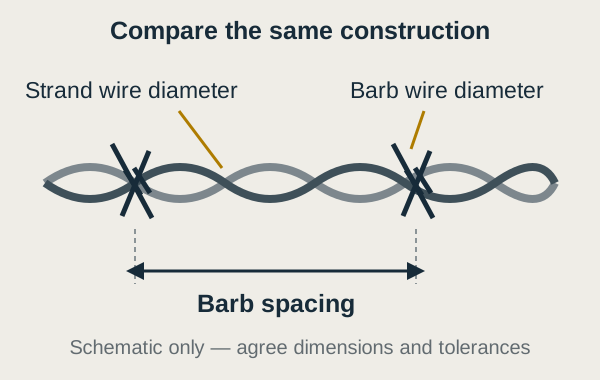
If an inquiry says only “12 gauge,” identify the applicable gauge system or request the actual diameter. Avoid substituting an AWG, SWG or other gauge table without agreement. A diameter in millimeters, with the governing unit and tolerance stated, makes comparison clearer. For dual-unit communication, NIST defines an inch as exactly 25.4 mm; a mathematical conversion does not establish a product tolerance.
2. Compare finished-wire length, not just the number of rolls
Record the declared length of finished barbed wire in each roll and the number of rolls. The total is length per roll × roll count. This is the length of the assembled barbed wire, not the combined lengths of its individual strand wires. Confirm the accepted length tolerance and the agreed verification method.
| Illustrative packing option | Quantity calculation | Finished-wire length |
|---|---|---|
| A: 200 m per roll, 50 rolls | 200 × 50 | 10,000 m |
| B: 250 m per roll, 40 rolls | 250 × 40 | 10,000 m |
These examples explain the comparison and do not confirm available roll sizes. The two totals are equal, but the offers are comparable only after construction, coating, tolerances and delivery scope also match. Fence-route coverage additionally depends on the number of wire runs and installation allowances agreed by the project team.
Ask for net product mass and gross packed mass as separate fields. Roll weight can be a useful consistency check when construction and length are already defined. It cannot replace a length check: different wire diameters, barbs, coatings and packaging can change mass.
3. Turn the coating description into a checkable requirement
Ask what coating is proposed for the strand wires and the barb wire, which specification or coating designation applies, and what records will support acceptance. The word “galvanized” alone does not identify every coating detail. If a buyer requires coating mass, a named coating class or a particular test, state the units, reference and acceptance method in the inquiry.
ASTM A121-22 is one published specification for metallic-coated carbon steel barbed wire. Its public scope identifies differing constructions and metallic coatings. If it is a project requirement, identify the edition and requested product designation and ask the supplier to confirm the applicable evidence. Mentioning a standard here does not establish APZLG product conformity.
For context, Bekaert's barbed-wire listings distinguish construction-related choices, roll length and coating. Those are that manufacturer's products and specifications; they should not be copied into an APZLG purchase order without confirmation.
4. Use a single comparison sheet for every supplier
| Compare this field | Ask the supplier to confirm |
|---|---|
| Construction | Strand count, twist construction, barb points and spacing, plus the drawing or approved sample reference. |
| Wire dimensions | Strand diameter and barb wire diameter, governing units, tolerances and measurement basis. |
| Material and mechanical requirements | Specified wire grade or strength requirement and proposed evidence. Do not substitute “high tensile” and “low carbon” descriptions without reviewing the actual requirement. |
| Coating | Coating type, applicable designation or agreed coating mass, relevant documents and acceptance method. |
| Order quantity | Finished-wire length per roll, roll count, total ordered length and length tolerance. |
| Packing | Net/gross mass, restraint, edge protection, handle or sleeve request, labels and pallet arrangement. |
| Inspection | Sample approval, dimensional checks, length verification and the records required before shipment. |
| Delivery scope | Destination and named port or place, agreed quotation terms, included services, timing and offer validity. |
Mark each response as confirmed, proposed alternative or awaiting clarification. Keep the same revision of the comparison sheet when requesting a revised offer. This gives the buyer and supplier a common reference for the order.
5. Keep packing and receipt requirements visible
For export orders, agree how rolls will be restrained and identified, and how sharp points will be protected during handling. State any sleeve, labeling or pallet request in the specification. Roll dimensions and packing arrangement affect shipment handling even when the total finished-wire length is unchanged. See the export packaging checklist for the wider handover.
Before dispatch, request the agreed identification and inspection records. At receipt, compare roll count, item labels and visible packing condition with the purchase documents. Decide in advance how any dimensional or length discrepancy will be investigated; a photograph of the outside of a roll cannot prove its full length.
Preparing inquiries for the US, Australia, UK and Western Europe
US buyers can include feet and inches alongside metric dimensions. Buyers in Australia, the UK and Western Europe can state millimeters and meters, retaining any original gauge or inch designation as a separate reference. In every case, identify the governing units and destination country. Local fencing, access and project requirements should be reviewed by the responsible buyer or contractor for the intended site.
For a repeat distributor order, include the previous approved drawing or sample reference and list any changes to the destination, labeling, packing or delivery requirement. The required documents, availability and timing should be reconfirmed for the new order.
Request a comparable specification proposal
Use the checklist below to request the relevant catalog and a proposal against one consistent specification. Attach a drawing, photograph or existing product schedule in your selected communication channel.
Guide #020 — Comparable Barbed Wire Inquiry
Destination country and named port/place or postcode:
Application and drawing/sample reference:
Strand construction and strand wire diameter with units/tolerance:
Barb wire diameter, point arrangement and spacing:
Gauge system, if referenced:
Required wire grade or mechanical requirement:
Coating type/designation and requested evidence:
Finished-wire length per roll and length tolerance:
Roll count and total finished-wire length:
Net/gross mass information requested:
Packing, label and pallet requirements:
Sample/inspection and delivery requirements:
Please send the relevant catalog and identify confirmed details, alternatives and items needing clarification.
Send your barbed-wire specification
Share dimensions, coating requirements, roll quantities and destination so our team can review the requested construction and the information needed for a quotation.
Frequently asked questions
Is a gauge number enough to compare barbed wire?
No. Identify the gauge system and the actual strand and barb wire diameters, with units and tolerances. A number without its measurement system can leave the construction unclear.
How do I compare different roll lengths?
Multiply the declared finished-wire length per roll by the roll count, then compare construction, coating, length tolerance, packing and delivery scope on the same basis.
Can roll weight replace a roll-length specification?
No. Wire dimensions, barb construction, coating and packaging can all affect mass. Agree finished-wire length and its verification separately from net and gross mass.
What coating information should be included in an inquiry?
State the coating type, any required designation or coating mass with units, the relevant specification and the evidence or acceptance checks needed. Confirm the supplied construction in the order.
Does a thicker strand automatically meet a high-tensile requirement?
No. Diameter alone does not establish wire grade or mechanical properties. State the required material or performance specification and ask for the proposed supporting records.
Does an ASTM reference mean APZLG products are certified?
No. A referenced standard provides context. Any required conformity, edition, product designation and test evidence must be confirmed for the actual product and order.
Can the roll length and packing be customized?
List the desired roll length, quantity and packing for review. Availability, tolerance, sample terms, order quantity and delivery timing need confirmation in the proposal.
What should I send for a comparable quotation?
Send a drawing or sample reference, strand and barb dimensions, construction, coating requirement, roll length and count, total finished-wire length, inspection needs, packing and destination.