
Choose outdoor mesh from the site conditions and the written material specification. A galvanized option needs a defined zinc-coating system; a stainless option needs a defined alloy grade and surface condition. Compare those details alongside mesh construction, inspection records and maintenance access before approving a substitute.
Site exposure · Comparison checklist · Material records · Request a review
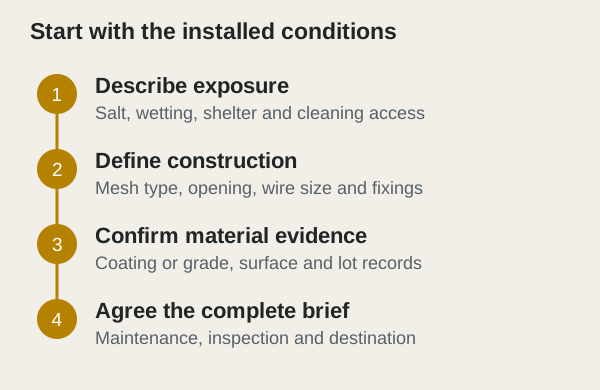
1. Describe the exposure before naming the metal
A rain-washed inland boundary, a sheltered coastal screen and a fence beside a road treated with de-icing salt are different purchasing briefs. Record how the mesh becomes wet, what can accumulate on it, and whether the installed surfaces can be reached for cleaning. Include photos of the proposed position, nearby structures and the fixing arrangement.
For galvanized steel, the American Galvanizers Association identifies temperature, humidity, rainfall, pollution and airborne salinity as relevant to atmospheric coating performance. Its general guidance is not a lifespan promise for a particular mesh order.
Use a short site note with every quotation request. State whether exposure means airborne spray, repeated splash, chemical contact, soil contact or immersion. These should not be grouped under one generic outdoor description. Ask the project specifier to identify any conditions that require a separate corrosion or engineering assessment.
2. Understand what each material description leaves open
Galvanized steel has a protective zinc coating on a steel base. Stainless steel relies on a passive surface film. ASSDA compares these different mechanisms. For procurement, turn the broad material name into an identifiable product requirement rather than comparing only the color or appearance in photographs.
For galvanized mesh, request the coating process, applicable designation or agreed coating requirement, and the fabrication sequence. Identify whether wire is coated before forming or welding, or the completed item is treated afterwards. Ask how weld areas, cut ends and any later site alterations will be addressed.
For stainless mesh, specify the grade designation and relevant product specification rather than writing only “stainless.” ASSDA explains that 316 provides greater resistance to chloride pitting than 304, while still having limits in aggressive conditions. This comparison does not make 316 suitable for every coastal or wet location.
3. Compare complete proposals on the same sheet
| Purchasing field | Galvanized proposal | Stainless proposal |
|---|---|---|
| Material identity | Steel base and defined zinc-coating process or designation. | Named alloy grade and the agreed product specification. |
| Finished condition | Coating sequence; condition at welds, bends and cut edges. | Surface finish; weld-cleaning and contamination-control requirements. |
| Evidence | Agreed coating and material records linked to the supplied lot. | Agreed grade and inspection records linked to the supplied lot. |
| Mesh geometry | Match construction, clear opening or mesh count, wire diameter, dimensions, edges and tolerances. | |
| Installation interfaces | Identify posts, frames, fasteners, dissimilar materials, drainage and any site cutting. | |
| Maintenance and acceptance | Agree inspection access, cleaning responsibilities, appearance expectations and what documents will close the order. | |
Keep alternatives in separate quotation lines. A switch from woven stainless cloth to a welded galvanized panel changes both material and construction. Review each change explicitly, with a drawing or sample reference. See the steel and stainless mesh page for product formats, the welded wire fence panel page for component scope, and chain link fence for roll construction.
4. Specify the evidence you need before placing the order
Ask the supplier to identify which material or coating records are proposed, what they cover, and how they connect to the supplied goods. If an inspection document or third-party check is required, state that in the request. A generic brochure or a photograph of a sample is not a substitute for an agreed lot record.
- Identify the drawing revision, material designation and any required specification edition.
- List the checks required for diameter, opening, finished dimensions and surface condition.
- Define what coating information or grade evidence must be reviewed.
- Agree sample approval, inspection responsibility and the records needed before dispatch.
- Record proposed deviations and obtain acceptance before they enter the order.
A coating test and an installed-life requirement are different matters. The AGA cautions against treating salt-spray testing as a predictor of real-world hot-dip galvanized longevity. If a project requests a test, define its method, specimen condition and acceptance criteria; do not turn hours into outdoor years without an applicable validated basis.
5. Include fabrication, fixings and maintenance in the review
Outokumpu explains that stainless performance depends on environment, surface condition, design, fabrication, contamination and maintenance. Chloride-containing conditions can cause localized attack. Material selection should therefore consider the finished mesh and its connections, rather than the wire grade alone.
ASSDA's coastal guidance emphasizes drainage, surface cleanliness, fabrication and ongoing washing. Sheltered areas can retain contaminants. Include access for inspecting and cleaning the mesh in the project brief; “stainless” should not be read as maintenance-free.
List frame and fastener materials as part of the supplied assembly. Have the project team review dissimilar-metal contacts, drainage and interfaces with existing structures. Agree who handles site cutting, coating repair or post-fabrication finishing where required. These responsibilities should be visible in the purchase documents and installer handover.
6. Make international inquiries easy to compare
US buyers may write galvanized; buyers in Australia and the UK often write galvanised. Use the same technical specification regardless of spelling. For the US, Australia, the UK and Western Europe, include destination country, named port or delivery place, local project requirements and the documents expected at receipt.
Give dimensions in millimeters and meters, adding inches and feet where helpful. State which units govern acceptance. If a wire gauge is referenced, identify its system and give the actual diameter as well; AWG and SWG numbers must not be treated as interchangeable. Distinguish bare-wire, coated-wire and overall polymer-coated diameter where applicable.
Count panels or rolls by size and identify the required finished length or area. Include edge finish, packing, labels, receiving constraints and the requested delivery window. Available construction, documentation, order quantity and timing must be confirmed in the proposal. For transport details, use the wire mesh export packaging checklist.
Send one brief for material and construction review
Use the following template to request the relevant catalog and a proposal. Where the final material has not been selected, ask for clearly identified alternatives against the same geometry and site brief.
Guide #021 — Outdoor Mesh Material Review
Destination country and named port/place or postcode:
Application and drawing/photo reference:
Exposure: inland/coastal/road salt/industrial/other:
Rain-washed or sheltered; wetting, drainage and cleaning access:
Mesh type: woven/welded/chain link; opening or mesh count:
Wire diameter, units, gauge system if used, and tolerance:
Roll/panel width and length; edge and fixing details:
Required galvanized coating or stainless grade; alternatives to review:
Fabrication/coating sequence and surface condition required:
Material/coating records and inspection requirements:
Quantity by size, packing and delivery requirements:
Please send the relevant catalog and identify confirmed details and proposed alternatives.
Request the relevant mesh catalog
Share your site conditions, drawing, dimensions, quantity and destination. Our team can review the requested product and identify details requiring confirmation.
Frequently asked questions
Is galvanized or stainless steel mesh better outdoors?
The choice depends on the exposure, specified construction and maintenance plan. Compare a defined zinc coating with a defined stainless grade; neither label alone establishes suitability for every outdoor site.
Is 316 stainless steel suitable for every coastal location?
No. Review salt exposure, shelter, temperature, surface finish, fabrication and cleaning access. Severe or continuously wet conditions need a specific material assessment; a 316 designation is not a universal service-life guarantee.
Are galvanized before welding and galvanized after welding the same specification?
No. Identify when the coating is applied, how welds and cut edges are treated, and the acceptance checks for the finished mesh. Compare the actual agreed construction.
Which documents should I request?
Specify the material grade or coating designation, the relevant product specification, inspection requirements and the records required for the actual lot. Agree traceability and document scope before ordering.
Can a salt-spray result tell me the installed service life?
Do not convert test hours into outdoor years without a validated, applicable basis. A test method, specimen condition and acceptance criterion should be agreed separately from any service-life requirement.
Does changing the metal grade confirm fence strength?
No. Opening, wire diameter, panel size, supports, connections and the engineering brief still need review. Material selection does not by itself establish a structural or security rating.
How should wire gauge be written in the inquiry?
Give the actual wire diameter in millimeters and, if useful, inches. Identify the gauge system when quoting a gauge number, and state the governing units, tolerances and whether diameter includes a coating.
What should I send for an outdoor mesh proposal?
Send site photos, exposure and cleaning conditions, product construction, material or finish requirement, dimensions, quantity, document needs, packing and destination country and port or place.
Sources and related reading
- Outokumpu: corrosion mechanisms, surface condition and material selection
- American Galvanizers Association: atmospheric exposure and zinc-coating performance
- ASSDA: grade 316 compared with 304
- ASSDA: coastal staining, fabrication and maintenance
- ASSDA: protective mechanisms of stainless and galvanised steel
- Stainless mesh for filtration: a separate process-use specification guide
- Agreeing order-specific quality checks