
Start with the pipe's actual outside diameter or measured circumference, a clear site photo and the quantity for each size. Then confirm stainless grade, strip geometry, fixing method, packing and destination with the supplier. A product photo alone cannot establish fit, and circumference alone is not a finished strip cutting length.
Measure the pipe · Compare specifications · Prepare your inquiry
What a pipe barrier is intended to address
Flexible stainless-steel rat climbing spike strips are considered for selected routes on pipes, posts or poles. The APZLG product uses a perforated strip with pointed projections; review its product page for the information needed to discuss an order. A site assessment should identify the route being addressed and any nearby structure that could provide another path.
Manufacturer guidance from Nixalite illustrates why round surfaces and alternative climbing paths require attention. Its proprietary models and installation dimensions are specific to its products. APZLG's strip layout and mounting arrangement must be confirmed separately.
1. Measure outside diameter and circumference
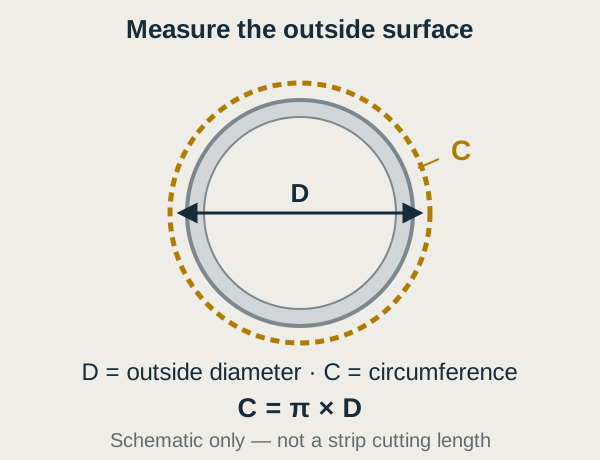
Use the actual outside surface at the proposed mounting position. Record the units, pipe shape, any insulation or coating and whether brackets interrupt the measurement. If access is safe, measure the circumference with a flexible tape; alternatively, a circular pipe's circumference can be calculated from its measured outside diameter using C = π × D. For a non-circular downpipe or irregular surface, provide a measured perimeter and photos rather than applying this circular formula.
| Measured outside diameter | Calculated circumference | Equivalent diameter |
|---|---|---|
| 76.2 mm | About 239.4 mm | 3.000 in |
| 100.0 mm | About 314.2 mm | About 3.937 in |
| 101.6 mm | About 319.2 mm | 4.000 in |
These are mathematical examples, not available sizes or guaranteed fits. NIST defines one inch as exactly 25.4 mm. Keep unrounded original measurements in the inquiry. A nominal pipe designation, such as NPS or DN, should be accompanied by the measured outside diameter for fit review.
2. Send photos that explain the mounting conditions
- Overview: the pipe from the ground or nearby access point to the roof or equipment, showing the route of concern.
- Mounting area: a closer view of the surface, brackets, joints, insulation and available space.
- Measurement: a readable diameter or circumference measurement with its unit.
- Adjacent routes: cables, walls, ledges, drains or support frames near the pipe.
State whether drilling is permitted and whether the pipe carries a service that restricts contact or modification. Identify public, pet or maintenance access. A qualified site team should review handling of sharp points and the appropriate fixing method before purchase.
3. Compare the complete specification
Ask each supplier to respond to the same fields. This helps distinguish an indicative product listing from an order-specific proposal.
| Field | What to send or confirm |
|---|---|
| Fit | Actual outside diameter or perimeter, pipe shape, units, mounting-space photos and quantity by size. |
| Material | Requested stainless grade, exposure and any required material documentation. Confirm the quoted grade in the order. |
| Strip construction | Proposed strip length, base width, thickness, point arrangement, openings and edge finish, supported by a drawing or sample. |
| Fixing | Site restrictions, proposed fastening method, hardware supplied and responsibility for final mounting approval. |
| Inspection | Which dimensions and records will be checked, and whether a sample or fit review is required before a bulk order. |
| Packing | Protected sharp points, item labels, quantity per pack and any distributor labeling requirements. |
| Delivery | Destination country, port or delivery postcode, requested date and quotation terms to be agreed. |
For example, “stainless spikes for 100 pipes” leaves important questions open. A size schedule listing measured outside diameters, quantities and mounting restrictions lets the team review each item more clearly. For export packing considerations, see our rolls, panels and coils packaging guide.
4. Keep the measurement and fixing allowances separate
Do not automatically order a strip whose length equals the calculated circumference. The chosen construction may need a join, an overlap, a fastener allowance or clearance; these depend on the design and surface. Ask the supplier to show the proposed assembled arrangement and confirm the allowance in the drawing or quotation. If several pipe sizes are involved, request labels that identify each group.
Review a sample or documented fit proposal before committing to a large repeated installation. The required grade, dimensions, fixing method, sample terms, order quantity and delivery timing remain subject to confirmation for the actual order.
Information for US, Australian, UK and Western European buyers
US inquiries can include inches alongside millimeters. Australian, UK and Western European inquiries can use millimeters, with any inch-based equipment description recorded as supplied. For every market, state the actual measured size and unit, destination and exposure conditions. Terms such as “downspout,” “downpipe,” “rat guard” or “anti-climb strip” should be accompanied by a product photo or drawing to identify the construction being requested.
Specify documentation and labeling requirements in the RFQ so they can be reviewed for the supplied product. Material grade, chemical declarations, conformity documents and country-specific acceptance should be confirmed individually rather than inferred from a generic listing.
Place the product within a wider prevention plan
The US EPA's rodent-prevention guidance includes excluding entry points and addressing food, water and shelter. A climbing strip addresses a selected route; the facility's prevention work also needs to consider openings and other access. Our earlier warehouse route-planning guide covers the broader application. This guide focuses on the measurements and purchasing information for a pipe-specific inquiry.
Send a ready-to-review inquiry
Use the fields below when requesting the relevant catalog and a specification review. Attach site and measurement photos in your email client, or share them with the team through your selected contact channel.
Guide #019 — Rat Climbing Spikes for Pipes
Destination country and port/postcode:
Buyer type (distributor / contractor / facility):
Pipe shape and actual outside diameter (mm or inches):
Measured circumference (same unit):
Pipe count and diameter groups:
Site / route photos available:
Surface, nearby cables or brackets and access restrictions:
Requested stainless grade and material documents:
Mounting preferences and whether drilling is permitted:
Quantity, packing and required delivery date:
Please send the relevant catalog and advise which details are needed for a quotation.
Request the pipe-barrier catalog
Send your measurements, photos and quantity. Our team can review the requested construction and identify the details needed for a quotation.
Frequently asked questions
Should I send the pipe diameter or circumference?
Send both when practical, with the measurement units and photos. Measure the actual outside surface. For a circular pipe, circumference is pi times outside diameter; nominal pipe size alone is not enough to review fit.
Does circumference give the strip cutting length?
No. Circumference is a starting measurement. The final strip length and any overlap, fixing allowance or clearance need confirmation for the selected product and installation.
Can I order by a 4-inch pipe description?
State whether 4 inches is the measured outside diameter or a nominal pipe designation. A measured outside diameter of 4 inches is 101.6 mm; the description does not by itself confirm compatibility.
Are stainless grades 304 and 316 interchangeable?
Do not substitute a grade without agreement. Identify the requested grade, exposure and documentation in the inquiry; availability and suitability need review for the specific order.
Can the strip be fitted without drilling?
Ask the team to review a fixing method for the pipe material and site. State any restriction on drilling or adhesives, and request confirmation of the supplied hardware and mounting arrangement before ordering.
How should a distributor handle several pipe sizes?
Send a size schedule with actual outside diameters or circumferences and quantities for each group. Ask for an itemized proposal, identification labels and a sample or fit review before confirming a bulk order.
Will spikes alone solve a rodent problem?
A physical barrier addresses a selected climbing route. Other access paths, openings, food and water sources still need assessment as part of a wider pest-management plan.
What is needed for an export quotation?
Send measurements, photos, surface and exposure details, requested grade, fixing restrictions, quantity by size, packing needs, destination country and port or postcode, and the required delivery date.